
Scaling GEMM with Warp Specialization and Clusters#
Overview
Step 7 assigns TMA load, MMA, and writeback to separate warp roles, then connects data readiness and buffer reuse with four barriers.
Step 8 uses cooperative MMA across two CTAs to compute a larger output tile, including cross-CTA operand access and barrier handoffs.
Step 9 adds a second MMA consumer so that two groups of A blocks share the same staged B tile. Under this chapter’s benchmark conditions, the final kernel matches the cuBLAS reference.
The pipelined GEMM from the previous chapter (Pipelining GEMM with TMA) already uses TMA, a software pipeline, and persistent scheduling, but the kernel still has only one warpgroup. It issues the TMA loads, waits for the A and B tiles, issues the MMA, and finally writes the result back. Although separate hardware units execute these operations, their control and synchronization remain concentrated in one warpgroup.
The SMEM ring and prefetch structure are already in place, but one warpgroup still controls every stage. While it waits for data, issues an MMA, or performs writeback, it cannot independently advance another part of the pipeline. Sustained overlap between data movement, matrix computation, and writeback requires assigning those jobs to separate warps.
This chapter broadens cooperation in three steps. Step 7 assigns TMA, MMA, and writeback to different warp roles. Step 8 lets two CTAs cooperate on a larger output tile. Step 9 adds a second MMA consumer. The GEMM itself does not change; the focus is how warps and CTAs divide the work and use barriers to hand off data and resources.
Step 7: Warp Specialization#
In the single-warpgroup kernel, every thread follows the same load, compute, and writeback path. The Tensor Cores have no work while data is being loaded, and the TMA engine may sit idle during computation. Warp specialization assigns these jobs to different warps and uses a software pipeline to pass data between them, allowing several stages to run concurrently.
Step 7 execution structure
Scope: the sequential load → MMA → writeback path in one warpgroup becomes three concurrent roles (TMA producer, MMA consumer, and writeback) connected by full/empty barriers.
Layout: unchanged, same SMEM stages and TMEM accumulator as Step 6.
Dispatch: unchanged, TMA loads,
tcgen05MMA.
The multi-stage SMEM pipeline and persistent ClusterPersistentScheduler2D carry over from Steps 5 and 6. Step 7 changes how that work is divided among warps and how the roles synchronize with one another.
From Sequential to Concurrent#
The figure below compares scheduling before and after warp specialization. The upper half uses the serial Step 4 timeline to summarize the unspecialized execution in Steps 4 through 6; the lower half shows the concurrent schedule in Step 7.
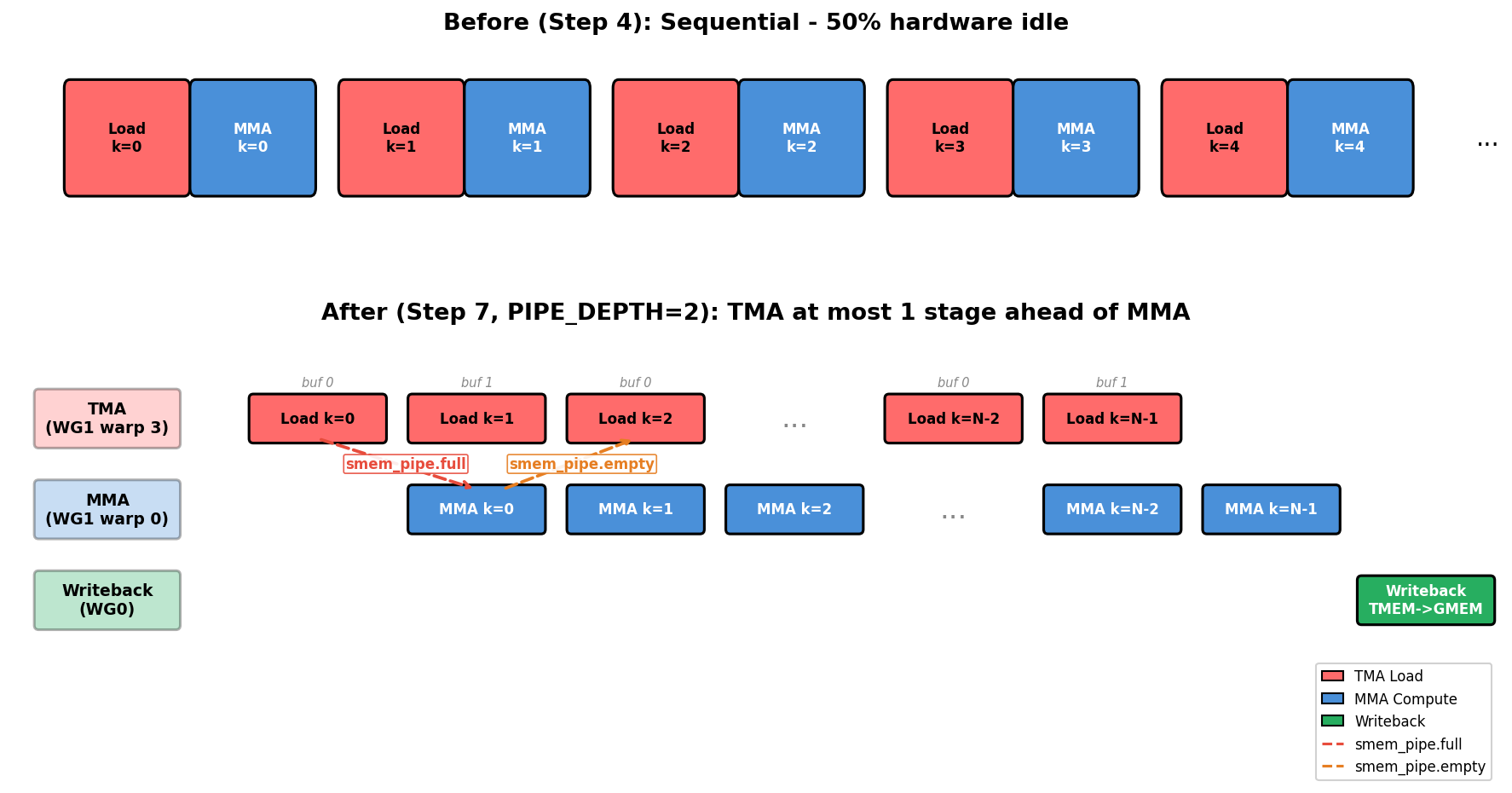
In the upper half, the same threads control both load and MMA, so one path can easily be idle while the other runs. Steps 5 and 6 add double buffering and persistent scheduling, but do not yet split load and compute into independent producer and consumer roles. In the lower half, the TMA producer prefetches the next tile while the MMA consumer computes the current tile, and writeback proceeds independently. Producer warp 3 can issue the next load while consumer warp 0 is still executing the current MMA.
The figure labels the full and empty states of the SMEM pipeline as smem_pipe.full and smem_pipe.empty. In the implementation below, these correspond to tma2mma and mma2tma.
Two barriers hand the SMEM buffer between load and MMA:
tma2mma(TMA → MMA): signals that the loaded SMEM data is ready for MMA to consume.mma2tma(MMA → TMA): signals that MMA has finished reading a buffer, so TMA can reuse it for the next load.
The mma2tma arrows skip one stage because of the ring-buffer reuse order. With PIPE_DEPTH=2, TMA Load k=0 fills stage 0 and TMA Load k=1 fills stage 1. Once MMA Compute k=0 finishes reading stage 0, the next operation that needs that slot is TMA Load k=2, not k=1. The signal from MMA Compute k=0 therefore releases stage 0 for TMA Load k=2.
Warp Roles#
With WG_NUMBER=2, the kernel uses two warpgroups and assigns load, compute, and writeback as follows:
Actor |
Location |
Job |
|---|---|---|
TMA Producer |
Warpgroup 1, warp 3 |
Continuously loads A and B tiles via TMA |
MMA Consumer |
Warpgroup 1, warp 0 |
Runs MMA as soon as data is ready |
Writeback |
Warpgroup 0 (all warps) |
Reads TMEM results, writes to GMEM |
Four Barriers#
The three concurrent roles communicate through four barriers. The forward path, TMA → MMA → Writeback, reports that data is ready. The reverse path, Writeback → MMA → TMA, returns each protected buffer or resource to the preceding role for reuse. Barrier names follow source2destination; for example, tma2mma carries the notification from TMA to MMA.
Barrier |
Type |
Direction |
Meaning |
|---|---|---|---|
tma2mma |
|
TMA -> MMA |
“SMEM data is ready” |
mma2tma |
|
MMA -> TMA |
“SMEM buffer can be reused” |
mma2ld |
|
MMA -> Writeback |
“TMEM results are ready” |
ld2mma |
|
Writeback -> MMA |
“TMEM is free for next tile” |
The barrier type depends on how its producer reports completion. TMA loads use TMABar, an mbarrier with byte counting that the TMA hardware updates after the transfer completes. TMA stores are tracked by the issuing thread through an async group: cp_async.bulk.commit_group() submits the group, and wait_group(0) waits for the write to finish. MMA operations use TCGen05Bar; tcgen05.commit() updates the barrier when the MMA completes.
In Step 7, each completion signal only needs to update a barrier in the current CTA, so these calls use cta_mask=0. Step 8 forms a two-CTA cluster and uses cta_mask=3 (binary 11) to update the corresponding barriers in both CTAs.
PipelineState#
The four barriers indicate when a buffer is available. PipelineState records which stage a role is using and which phase of that stage it should wait for. Maintaining both values by hand is prone to off-by-one errors that can deadlock the kernel, so PipelineState keeps them together:
tma_ps = PipelineState(PIPE_DEPTH, phase=1)   # Producer starts ready (phase=1)
# tma_ps.stage = current stage index
# tma_ps.phase = current phase (0 or 1)
tma_ps.advance()                          # Advance to next stage
The initial phase determines whether a role’s first wait passes or blocks. The two ends of the pipeline need opposite initial states:
phase=1(producer): the firstwait(phase=1)sees the barrier at phase 0 and passes immediately. The buffers start empty, so the producer can begin filling them.phase=0(consumer): the firstwait(phase=0)sees the barrier at phase 0 and blocks. No data is available until the producer finishes the first load.
If both ends use the same initial phase, the kernel may deadlock or continue before the data is ready.
Synchronizing the Writeback Warpgroup with warpgroup_sync#
In Step 7, all 128 threads in Warpgroup 0 perform writeback. They first write their register values to Dsmem, wait until the complete tile is present, and then allow one thread to issue the TMA store. This requires synchronization within Warpgroup 0, but cta_sync() cannot be used inside the branch: the other warpgroup is executing the producer and MMA consumer paths and will never reach that synchronization point. Waiting for the entire CTA would deadlock.
warpgroup_sync(10) lowers to:
bar.sync 10, 128
PTX calls this ID-selected CTA barrier a named barrier. Here, 10 is the barrier ID, and 128 is the required number of thread arrivals. This mechanism is distinct from the shared-memory mbarrier objects used earlier to track asynchronous completion: bar.sync blocks the executing threads until the requested number of threads have reached the same barrier ID.
The instruction does not identify the warpgroup automatically. It synchronizes Warpgroup 0 here because only those 128 threads execute this code, and all of them use ID 10. The first warpgroup_sync(10) ensures that Dsmem is complete. The second ensures that the selected thread has waited for the TMA store before the remaining threads continue to the next tile.
Each CTA has 16 such barrier slots, numbered 0 through 15. Threads participating in one synchronization must use the same ID, while independent synchronizations need different IDs. Step 7 has only one writeback warpgroup and uses ID 10. Step 9 has two writeback warpgroups and calls warpgroup_sync(wg_id + 10), assigning IDs 10 and 11 so their arrivals are not counted together.
Epilogue (Writeback)#
In Step 7, BLK_N=128, so the writeback warpgroup can read the entire TMEM tile into registers in one pass and issue one TMA store. The sequence is:
Wait for MMA with
mma2ld.wait(wb_ps.stage, wb_ps.phase), then executeT.ptx.tcgen05.fence.after_thread_sync()to order the subsequenttcgen05.ldafter the cross-thread completion notification.Read TMEM into registers. Each thread receives 128 fp32 values; the warpgroup issues
Tx.wg.copy_async(reg_wg, tmem[:, :BLK_N])and waits for the load withT.ptx.tcgen05.wait.ld().Have all 128 writeback threads execute
ld2mma.arrive(0), indicating that the TMEM region can be used by the next tile. With no remote rank,arrive()targets the current CTA’s local barrier, and every writeback thread reports one arrival. Steps 8 and 9 instead use aremote_view(0)so both CTAs update CTA 0’s barrier.Convert fp32 to fp16 in registers.
Write the registers to
Dsmem, then executefence.proxy_async("shared::cta")andwarpgroup_sync(10).Use TMA to store
Dsmemto GMEM, withcp_async.bulk.commit_group()andwait_group(0)tracking completion.
The mbarrier wait and tcgen05.wait.ld() wait for different operations. The former confirms that MMA has completed, fence.after_thread_sync() establishes cross-thread tcgen05 ordering, and the latter confirms that the asynchronous TMEM load has populated its destination registers.
Complete Kernel#
The complete Step 7 kernel combines the role assignment, four barriers, PipelineState, and writeback path described above. It retains the persistent scheduler from Step 6 and uses PIPE_DEPTH=2, the minimum depth needed to overlap load and compute. A deeper pipeline can hide more memory latency, but also consumes more SMEM.
import tvm
from tvm.script import tirx as T
from tvm.script.tirx import tile as Tx
from tvm.tirx.layout import TileLayout, S, TLane, TCol, tid_in_wg
from tvm.backend.cuda.tile_primitive.tma_utils import mma_shared_layout, SwizzleMode
from tvm.backend.cuda.lang.pipeline import TMABar, TCGen05Bar, MBarrier, PipelineState
from tvm.backend.cuda.lang.tile_scheduler import ClusterPersistentScheduler2D

SM_COUNT = 148  # Number of SMs on NVIDIA B200 GPU
F16_SIZE = 2

def hgemm_v7(M, N, K):
    a_type = tvm.DataType("float16")
    b_type = tvm.DataType("float16")
    d_type = tvm.DataType("float16")
    acc_type = tvm.DataType("float32")

    BLK_M, BLK_N, BLK_K = 128, 128, 64
    K_TILES = K // BLK_K
    PIPE_DEPTH = 2
    WG_NUMBER = 2

    A_layout = mma_shared_layout(a_type, SwizzleMode.SWIZZLE_128B_ATOM, (PIPE_DEPTH, BLK_M, BLK_K))
    B_layout = mma_shared_layout(b_type, SwizzleMode.SWIZZLE_128B_ATOM, (PIPE_DEPTH, BLK_N, BLK_K))
    D_layout = mma_shared_layout(d_type, SwizzleMode.SWIZZLE_128B_ATOM, (BLK_M, BLK_N))

    @T.prim_func
    def kernel(
        A: T.Buffer((M, K), a_type),
        B: T.Buffer((N, K), b_type),
        D: T.Buffer((M, N), d_type),
    ):
        T.device_entry()
        bx = T.cta_id([SM_COUNT])
        wg_id = T.warpgroup_id([WG_NUMBER])
        warp_id = T.warp_id_in_wg([4])
        lane_id = T.lane_id([32])

        # --- Allocation ---
        pool = T.SMEMPool()
        tmem_addr = pool.alloc((1,), "uint32")
        tma2mma = TMABar(pool, PIPE_DEPTH)
        mma2tma = TCGen05Bar(pool, PIPE_DEPTH)
        mma2ld  = TCGen05Bar(pool, 1)
        ld2mma  = MBarrier(pool, 1)
        pool.move_base_to(1024)
        Asmem = pool.alloc((PIPE_DEPTH, BLK_M, BLK_K), a_type, layout=A_layout)
        Bsmem = pool.alloc((PIPE_DEPTH, BLK_N, BLK_K), b_type, layout=B_layout)
        Dsmem = pool.alloc((BLK_M, BLK_N), d_type, layout=D_layout)

        # --- Barrier init ---
        tma2mma.init(1)
        mma2tma.init(1)
        mma2ld.init(1)
        ld2mma.init(128)   # all 128 Warpgroup 0 threads arrive
        pool.commit()

        # --- TMEM alloc + fence ---
        if wg_id == 0:
            if warp_id == 0:
                T.ptx.tcgen05.alloc(T.address_of(tmem_addr), n_cols=512, cta_group=1)
        T.ptx.fence.proxy_async("shared::cta")
        T.ptx.fence.mbarrier_init()
        T.cuda.cta_sync()

        tmem = T.decl_buffer(
            (128, 512), acc_type, scope="tmem", allocated_addr=tmem_addr[0],
            layout=TileLayout(S[(128, 512) : (1@TLane, 1@TCol)]))

        # --- Tile scheduler ---
        tile_scheduler = ClusterPersistentScheduler2D(
            "ts", num_m_tiles=M // BLK_M, num_n_tiles=N // BLK_N,
            l2_group_size=8, num_clusters=SM_COUNT)
        tile_scheduler.init(bx)
        m_st = T.meta_var(tile_scheduler.m_idx * BLK_M)
        n_st = T.meta_var(tile_scheduler.n_idx * BLK_N)

        # =============================================
        # Warpgroup 1: TMA Producer (warp 3) + MMA Consumer (warp 0)
        # =============================================
        if wg_id == 1:
            if warp_id == 3:
                # === TMA Producer ===
                tma_ps = PipelineState(PIPE_DEPTH, phase=1)

                @T.inline
                def tma_load(k_offset):
                    Tx.copy_async(Asmem[tma_ps.stage, :, :],
                                  A[m_st:m_st+BLK_M, k_offset:k_offset+BLK_K],
                                  dispatch="tma_auto", cta_group=1,
                                  mbar=tma2mma.ptr_to([tma_ps.stage]))
                    Tx.copy_async(Bsmem[tma_ps.stage, :, :],
                                  B[n_st:n_st+BLK_N, k_offset:k_offset+BLK_K],
                                  dispatch="tma_auto", cta_group=1,
                                  mbar=tma2mma.ptr_to([tma_ps.stage]))

                if T.filter(lane_id, T.ptx.elect_sync()):
                    while tile_scheduler.valid():
                        for k in range(K_TILES):
                            mma2tma.wait(tma_ps.stage, tma_ps.phase)
                            tma_load(k * BLK_K)
                            tma2mma.arrive(tma_ps.stage,
                                           (BLK_M * BLK_K + BLK_N * BLK_K) * F16_SIZE)
                            tma_ps.advance()
                        tile_scheduler.next_tile()

            elif warp_id == 0:
                # === MMA Consumer ===
                mma_ps = PipelineState(PIPE_DEPTH, phase=0)
                ld_ps = PipelineState(1, phase=1)

                if T.filter(lane_id, T.ptx.elect_sync()):
                    while tile_scheduler.valid():
                        # Wait for TMEM to be free from previous tile's writeback
                        ld2mma.wait(ld_ps.stage, ld_ps.phase)
                        ld_ps.advance()

                        for k in range(K_TILES):
                            tma2mma.wait(mma_ps.stage, mma_ps.phase)
                            Tx.gemm_async(
                                tmem[:, :BLK_N],
                                Asmem[mma_ps.stage, :, :],
                                Bsmem[mma_ps.stage, :, :],
                                accum=(k != 0), dispatch="tcgen05", cta_group=1)
                            mma2tma.arrive(mma_ps.stage, cta_group=1, cta_mask=0)
                            mma_ps.advance()

                        # Signal results ready for writeback
                        mma2ld.arrive(0, cta_group=1, cta_mask=0)
                        tile_scheduler.next_tile()

        # =============================================
        # Warpgroup 0: Writeback
        # =============================================
        elif wg_id == 0:
            wb_ps = PipelineState(1, phase=0)
            reg_f16 = T.alloc_local((BLK_N,), d_type)

            while tile_scheduler.valid():
                # Wait for MMA results
                mma2ld.wait(wb_ps.stage, wb_ps.phase)
                wb_ps.advance()
                T.ptx.tcgen05.fence.after_thread_sync()

                # Read TMEM -> registers (warpgroup scope)
                reg = T.alloc_local((BLK_N,), acc_type)
                reg_wg = reg.view(128, BLK_N,
                    layout=TileLayout(S[(128, BLK_N) : (1@tid_in_wg, 1)]))
                Tx.wg.copy_async(reg_wg[:], tmem[:, :BLK_N])
                T.ptx.tcgen05.wait.ld()

                # Signal TMEM free (all 128 threads arrive)
                ld2mma.arrive(0)

                # Cast fp32 -> fp16
                Tx.cast(reg_f16[:], reg[:])

                # Write to Dsmem + TMA store
                Tx.copy(Dsmem[warp_id * 32 + lane_id, :], reg_f16[:])
                T.ptx.fence.proxy_async("shared::cta")
                T.cuda.warpgroup_sync(10)
                if warp_id == 0:
                    if lane_id == 0:
                        Tx.copy_async(D[m_st:m_st+BLK_M, n_st:n_st+BLK_N],
                                      Dsmem[:, :], dispatch="tma_auto")
                        T.ptx.cp_async.bulk.commit_group()
                        T.ptx.cp_async.bulk.wait_group(0)
                T.cuda.warpgroup_sync(10)

                tile_scheduler.next_tile()

        # --- Cleanup ---
        T.cuda.cta_sync()
        if warp_id == 0:
            T.ptx.tcgen05.relinquish_alloc_permit(cta_group=1)
            T.ptx.tcgen05.dealloc(tmem_addr[0], n_cols=512, cta_group=1)

    return kernel
Checking Barrier Handoffs#
Step 7 connects three roles with four barriers. If the kernel waits indefinitely, inspect each barrier in turn: which role waits, which role arrives, and whether the initialized arrival count matches the number of notifications. If the kernel finishes but produces the wrong result, check whether a consumer reads data before the required wait and fence have completed.
Also verify when each storage region becomes reusable. TMA may overwrite an Asmem or Bsmem stage only after mma2tma completes. MMA may overwrite the TMEM accumulator only after ld2mma completes. A later writeback may reuse Dsmem only after the previous TMA store finishes. Following these handoffs narrows a deadlock or wrong result to one data transition instead of the entire pipeline.
Trace the barriers: follow one K tile through tma2mma, mma2tma, mma2ld, and ld2mma. For each barrier, identify who waits, who arrives, which data becomes safe to read, and which buffer becomes reusable.
SMEM Cost of Pipeline Depth#
PIPE_DEPTH=2 provides two A/B stage pairs: while MMA reads one pair, TMA can fill the other. Increasing the depth lets the producer prepare more tiles in advance, but every additional stage allocates another Asmem and Bsmem pair.
With BLK_M=BLK_N=128, BLK_K=64, and fp16 operands, each stage uses:
(128×64 + 128×64) × 2 bytes = 32 KB
The Dsmem writeback buffer requires another 32 KB. PIPE_DEPTH=4 therefore uses roughly 4×32+32=160 KB, while PIPE_DEPTH=6 uses about 6×32+32=224 KB, excluding the small amount of metadata used by barriers and other state. A B200 SM provides 228 KB of shared memory, so depth 6 nearly exhausts the available capacity. A deeper pipeline is not necessarily faster and may make the current tile shape impossible to launch.
Step 8: Two-CTA Cluster#
Step 7 coordinates several roles within one CTA. Step 8 extends that cooperation to a cluster of two CTAs.
Step 8 execution structure
Scope: the cooperating scope now spans two CTAs in a cluster, not one.
Layout: A and B slices reside in the SMEM of both CTAs, while the accumulator spans their two TMEM spaces.
Dispatch:
Tx.gemm_asyncusescta_group=2to issue a two-CTA cooperative MMA, andcta_mask=3sends completion notifications to both CTAs.
How A and B Are Split Across the CTAs#
The figure below divides one \(256\times256\) output tile between two CTAs. Start with the Asmem blocks: CTA 0 loads rows 0–127 of A, while CTA 1 loads rows 128–255. These slices determine the output rows owned by each CTA, so the two orange regions are D[0:128, 0:256] and D[128:256, 0:256].
Now consider the two Bsmem blocks. B is stored with shape N×K, so the stored-B rows loaded by CTA 0 and CTA 1 become the first and second groups of 128 output columns after B.T. Each CTA must compute all 256 columns for its own 128 output rows. The cooperative MMA therefore follows the cross-CTA reads in the center of the figure to access the other CTA’s Bsmem as well. Each A slice is multiplied by both B slices.
Click either Asmem or Bsmem, or the cross-CTA reads in the center, to see how each part participates in the cooperative MMA.
The tile scheduler returns (m_idx, n_idx) for one \(256\times256\) cluster output tile. Let its upper-left corner be m_base = m_idx * 256 and n_base = n_idx * 256. The two CTAs divide the work as follows:
CTA |
A slice loaded |
Stored-B slice loaded |
D region written |
|---|---|---|---|
CTA 0 |
|
|
|
CTA 1 |
|
|
|
In Step 7, one CTA loads one \(128\times K\) slice of A and one \(128\times K\) slice of B to compute a \(128\times128\) output tile. The cluster now loads two slices from each operand, doubling the staged operand data, while the \(256\times256\) output tile contains four times as many elements. Because both A slices are multiplied by both B slices, each staged operand participates in roughly twice as much computation.
Tile Address Calculation#
The scheduler now operates on \(256\times256\) cluster tiles, so the numbers of tiles along M and N are M // 256 and N // 256.
cbx is the CTA’s position in the cluster and is either 0 or 1. Starting from m_base and n_base, each CTA uses cbx to select the A and B slices it loads:
cbx, cby = T.cta_id_in_cluster([CTA_GROUP, 1])
m_st = m_base + cbx * BLK_M
n_st = n_base + cbx * BLK_N
CTA 0 starts at m_base and n_base; CTA 1 advances each address by 128 rows. m_st is also the first output row written by that CTA. n_st only selects the stored-B rows that the CTA contributes to the cooperative MMA.
Both B slices participate in the MMA, so each CTA receives all 256 output columns for its own 128 rows. The epilogue writes those columns in two 128-column chunks, selected by no=0,1:
n_st_epi = n_base + no * BLK_N
There is no cbx in this expression: cbx selects the B slice loaded by the CTA, not the output columns it writes.
Data Handoffs Within the Cluster#
The two CTAs have separate SMEM spaces and barriers. A cooperative MMA must wait until both sets of A and B slices are ready, then notify both CTAs when the relevant results or buffers can be used. This requires three handoffs.
TMA → MMA. This implementation uses CTA 0’s tma2mma barrier to track the TMA loads issued by both CTAs. Both sides refer to it through the same remote view:
tma2mma_cta0 = tma2mma.remote_view(0)
The TMA loads from both CTAs report completion to this barrier. The selected producer thread in CTA 0 registers the combined byte count for both CTAs. Each CTA loads one BLK_M×BLK_K A slice and one BLK_N×BLK_K B slice, so the count is:
CTA_GROUP * (BLK_M * BLK_K + BLK_N * BLK_K) * F16_SIZE
The MMA consumer in CTA 0 can proceed only after all of these bytes have been transferred.
MMA → TMA and writeback. A cooperative MMA is issued once. The if cbx == 0: guard keeps only the MMA path in CTA 0, where one selected thread issues the operation with cta_group=2:
if cbx == 0:
    Tx.gemm_async(..., cta_group=2)
The hardware reads SMEM from both CTAs and updates the TMEM accumulator on both sides. After each asynchronous MMA in the K-loop, the same thread registers a completion notification through mma2tma. After the entire K-loop has been issued, it registers the final accumulator notification through mma2ld:
for k in range(K_TILES):
    Tx.gemm_async(..., cta_group=2)
    mma2tma.arrive(mma_ps.stage, cta_group=2, cta_mask=3)

mma2ld.arrive(0, cta_group=2, cta_mask=3)
cta_mask=3 is binary 11, so both CTA 0 and CTA 1 receive the notification. Once an MMA finishes, mma2tma allows the TMA producers on both sides to reuse the SMEM stage it consumed. Once the K-loop finishes, mma2ld tells the writeback warpgroup in each CTA that the TMEM accumulator is ready.
Writeback → the next output tile. After the writeback warpgroups have finished using TMEM, 128 threads in each CTA arrive on CTA 0’s ld2mma barrier. Its expected arrival count is therefore 128 * CTA_GROUP, or 256. Only after all arrivals have been received may the next output tile reuse that TMEM region.
TMEM allocation and deallocation also use cta_group=2. Before deallocation, cluster_sync() ensures that both CTAs have finished accessing TMEM. The writeback path divides the 256 output columns into two 128-column chunks. It loads and stores one half at a time, so each thread does not need to keep 256 fp32 values live at once.
Complete Kernel#
The complete kernel combines the tile partition, cooperative MMA, and cross-CTA barrier protocol:
def hgemm_v8(M, N, K):
    a_type = tvm.DataType("float16")
    b_type = tvm.DataType("float16")
    d_type = tvm.DataType("float16")
    acc_type = tvm.DataType("float32")

    CTA_GROUP = 2
    BLK_M, BLK_N, BLK_K = 128, 128, 64
    MMA_M, MMA_N = 256, 256
    K_TILES = K // BLK_K
    PIPE_DEPTH = 4
    WG_NUMBER = 2
    F16_SIZE = 2  # fp16

    A_layout = mma_shared_layout(a_type, SwizzleMode.SWIZZLE_128B_ATOM, (PIPE_DEPTH, BLK_M, BLK_K))
    B_layout = mma_shared_layout(b_type, SwizzleMode.SWIZZLE_128B_ATOM, (PIPE_DEPTH, BLK_N, BLK_K))
    D_layout = mma_shared_layout(d_type, SwizzleMode.SWIZZLE_128B_ATOM, (BLK_M, 128))

    @T.prim_func
    def kernel(
        A: T.Buffer((M, K), a_type),
        B: T.Buffer((N, K), b_type),
        D: T.Buffer((M, N), d_type),
    ):
        T.device_entry()
        bx = T.cta_id([SM_COUNT])
        cbx, cby = T.cta_id_in_cluster([CTA_GROUP, 1])
        wg_id = T.warpgroup_id([WG_NUMBER])
        warp_id = T.warp_id_in_wg([4])
        lane_id = T.lane_id([32])

        # --- Allocation ---
        pool = T.SMEMPool()
        tmem_addr = pool.alloc((1,), "uint32")
        tma2mma = TMABar(pool, PIPE_DEPTH)
        mma2tma = TCGen05Bar(pool, PIPE_DEPTH)
        mma2ld  = TCGen05Bar(pool, 1)
        ld2mma  = MBarrier(pool, 1)
        pool.move_base_to(1024)
        Asmem = pool.alloc((PIPE_DEPTH, BLK_M, BLK_K), a_type, layout=A_layout)
        Bsmem = pool.alloc((PIPE_DEPTH, BLK_N, BLK_K), b_type, layout=B_layout)
        Dsmem = pool.alloc((BLK_M, 128), d_type, layout=D_layout)

        # --- Barrier init ---
        tma2mma.init(1)
        mma2tma.init(1)
        mma2ld.init(1)
        ld2mma.init(128 * CTA_GROUP)  # both CTAs' writeback threads
        pool.commit()

        # --- TMEM alloc (cooperative) ---
        if wg_id == 0:
            if warp_id == 0:
                T.ptx.tcgen05.alloc(T.address_of(tmem_addr), n_cols=512, cta_group=CTA_GROUP)
        T.ptx.fence.proxy_async("shared::cta")
        T.ptx.fence.mbarrier_init()
        T.cuda.cta_sync()

        tmem = T.decl_buffer(
            (128, 512), acc_type, scope="tmem", allocated_addr=tmem_addr[0],
            layout=TileLayout(S[(128, 512) : (1@TLane, 1@TCol)]))

        # --- Tile scheduler (cluster tiles) ---
        tile_scheduler = ClusterPersistentScheduler2D(
            "ts", num_m_tiles=M // 256, num_n_tiles=N // 256,
            l2_group_size=8, num_clusters=SM_COUNT // CTA_GROUP)
        tile_scheduler.init(bx // CTA_GROUP)
        m_idx = T.meta_var(tile_scheduler.m_idx)
        n_idx = T.meta_var(tile_scheduler.n_idx)
        m_st = T.meta_var((m_idx * CTA_GROUP + cbx) * BLK_M)
        n_st = T.meta_var((n_idx * CTA_GROUP + cbx) * BLK_N)

        # --- Cross-CTA barrier view ---
        tma2mma_cta0 = tma2mma.remote_view(0)
        ld2mma_cta0 = ld2mma.remote_view(0)

        # =============================================
        # Warpgroup 1: TMA Producer (warp 3) + MMA Consumer (warp 0)
        # =============================================
        if wg_id == 1:
            if warp_id == 3:
                tma_ps = PipelineState(PIPE_DEPTH, phase=1)

                @T.inline
                def tma_load(k_offset):
                    Tx.copy_async(Asmem[tma_ps.stage, :, :],
                                  A[m_st:m_st+BLK_M, k_offset:k_offset+BLK_K],
                                  dispatch="tma_auto", cta_group=CTA_GROUP,
                                  mbar=tma2mma_cta0.ptr_to([tma_ps.stage]))
                    Tx.copy_async(Bsmem[tma_ps.stage, :, :],
                                  B[n_st:n_st+BLK_N, k_offset:k_offset+BLK_K],
                                  dispatch="tma_auto", cta_group=CTA_GROUP,
                                  mbar=tma2mma_cta0.ptr_to([tma_ps.stage]))

                if T.filter(lane_id, T.ptx.elect_sync()):
                    while tile_scheduler.valid():
                        for k in range(K_TILES):
                            mma2tma.wait(tma_ps.stage, tma_ps.phase)
                            tma_load(k * BLK_K)
                            if cbx == 0:
                                tma2mma_cta0.arrive(tma_ps.stage,
                                    CTA_GROUP * (BLK_M * BLK_K + BLK_N * BLK_K) * F16_SIZE)
                            tma_ps.advance()
                        tile_scheduler.next_tile()

            elif warp_id == 0:
                mma_ps = PipelineState(PIPE_DEPTH, phase=0)
                ld_ps = PipelineState(1, phase=1)

                if cbx == 0:
                    if T.filter(lane_id, T.ptx.elect_sync()):
                        while tile_scheduler.valid():
                            ld2mma.wait(ld_ps.stage, ld_ps.phase)
                            ld_ps.advance()

                            for k in range(K_TILES):
                                tma2mma.wait(mma_ps.stage, mma_ps.phase)
                                Tx.gemm_async(
                                    tmem[:, :MMA_N],
                                    Asmem[mma_ps.stage, :, :],
                                    Bsmem[mma_ps.stage, :, :],
                                    accum=(k != 0), dispatch="tcgen05", cta_group=CTA_GROUP)
                                mma2tma.arrive(mma_ps.stage, cta_group=CTA_GROUP, cta_mask=3)
                                mma_ps.advance()

                            mma2ld.arrive(0, cta_group=CTA_GROUP, cta_mask=3)
                            tile_scheduler.next_tile()

        # =============================================
        # Warpgroup 0: Writeback (256 columns in 2 x 128-column chunks)
        # =============================================
        elif wg_id == 0:
            wb_ps = PipelineState(1, phase=0)
            reg_f16 = T.alloc_local((128,), d_type)

            while tile_scheduler.valid():
                mma2ld.wait(wb_ps.stage, wb_ps.phase)
                wb_ps.advance()
                T.ptx.tcgen05.fence.after_thread_sync()

                for no in T.unroll(2):  # 2 chunks of 128 columns = 256 total
                    reg = T.alloc_local((128,), acc_type)
                    reg_wg = reg.view(128, 128,
                        layout=TileLayout(S[(128, 128) : (1@tid_in_wg, 1)]))
                    Tx.wg.copy_async(reg_wg[:], tmem[:, no * 128:(no + 1) * 128])
                    T.ptx.tcgen05.wait.ld()
                    Tx.cast(reg_f16[:], reg[:])
                    Tx.copy(Dsmem[warp_id * 32 + lane_id, :], reg_f16[:])
                    T.ptx.fence.proxy_async("shared::cta")
                    T.cuda.warpgroup_sync(10)
                    if warp_id == 0:
                        if lane_id == 0:
                            n_st_epi = T.meta_var(n_idx * 256 + no * 128)
                            Tx.copy_async(D[m_st:m_st+BLK_M, n_st_epi:n_st_epi+128],
                                          Dsmem[:, :], dispatch="tma_auto")
                            T.ptx.cp_async.bulk.commit_group()
                            T.ptx.cp_async.bulk.wait_group(0)
                    T.cuda.warpgroup_sync(10)

                ld2mma_cta0.arrive(0)
                tile_scheduler.next_tile()

        # --- Cleanup ---
        T.cuda.cluster_sync()
        if warp_id == 0:
            T.ptx.tcgen05.relinquish_alloc_permit(cta_group=CTA_GROUP)
            T.ptx.tcgen05.dealloc(tmem_addr[0], n_cols=512, cta_group=CTA_GROUP)

    return kernel
Step 9: Multi-Consumer Warp Specialization#
In Step 8, one cooperative MMA uses A and B slices from both CTAs to compute a \(256\times256\) output tile. Step 9 issues two such MMAs in the same two-CTA cluster. They read different A rows but share the same B slices. The amount of B loaded into each stage stays fixed, while the cluster output grows along M to \(512\times256\).
Step 9 execution structure
Scope: CTA 0 now has two consumer warps that issue MMA operations, selected by
warp_id.Layout: A gains a consumer axis, and TMEM is divided into two accumulator ranges; both consumers reuse the same staged B tile.
Dispatch: the kernel still uses
tcgen05withcta_group=2, but issues a separate cooperative MMA for each consumer.
Which Rows Each Consumer Computes#
Let m_base and n_base denote the origin of the current cluster tile. Consumer 0 computes the first 256 rows, and consumer 1 computes the next 256. Within each consumer, CTA 0 and CTA 1 contribute 128 rows apiece. Both MMAs use B[n_base:n_base+256, :], so they cover the same 256 output columns:
Consumer |
A / D rows in CTA 0 |
A / D rows in CTA 1 |
B rows supplied by the CTA pair |
TCol range in each CTA’s TMEM |
Writeback |
|---|---|---|---|---|---|
0 |
|
|
|
|
WG 0 |
1 |
|
|
|
|
WG 1 |
Each consumer in the table represents one cooperative MMA spanning both CTAs. The corresponding MMA issue warp in CTA 0 only issues the instruction; the hardware then reads the A and B slices from both CTAs and writes each CTA’s 128 output rows into its local TMEM. Together, the two consumers cover D[m_base:m_base+512, n_base:n_base+256].
Warp Roles#
The kernel uses two MMA issue warps for these cooperative MMAs and two writeback warpgroups for their accumulators. Within each issue warp, only the thread selected by elect_sync() issues the instruction. With NUM_CONSUMER=2 and WG_NUMBER=3, the roles are assigned as follows:
Warpgroup |
Warp |
Role |
|---|---|---|
WG 2 |
warp 0 |
MMA issue warp 0: the selected thread in CTA 0 issues consumer 0’s MMA with |
WG 2 |
warp 1 |
MMA issue warp 1: the selected thread in CTA 0 issues consumer 1’s MMA with |
WG 2 |
warp 3 |
TMA producer: each CTA loads its local two A blocks and one B block |
WG 0 |
all warps |
Each CTA writes its local output rows for consumer 0, reading TMEM |
WG 1 |
all warps |
Each CTA writes its local output rows for consumer 1, reading TMEM |
The consumers need different A blocks because they compute different output rows. They use the same B slices because both sets of results cover the same output columns. One set of staged B slices can therefore participate in two cooperative MMAs, roughly halving the B-load cost relative to the amount of computation.
Adding the Second MMA Consumer#
Adding the second consumer requires coordinated changes to the layouts, barriers, and tile scheduler.
Extend the operand and accumulator layouts. Asmem gains a dimension of length NUM_CONSUMER, allowing each stage to hold two A blocks:
Asmem = pool.alloc(
    (PIPE_DEPTH, NUM_CONSUMER, BLK_M, BLK_K), ...
)
The TMA producer in each CTA loads Asmem[stage, 0], Asmem[stage, 1], and its local Bsmem[stage]. The consumers share the B slices, so no second B block is needed. The total byte count registered for the TMA loads from both CTAs is:
CTA_GROUP * (
    NUM_CONSUMER * BLK_M * BLK_K + BLK_N * BLK_K
) * F16_SIZE
The two MMA warps use warp_id to select their A block and write to TMEM cols [0:256] and [256:512], respectively.
Update the barriers. tma2mma and mma2tma remain indexed by pipeline stage. Once TMA has loaded two A blocks and one B block for a stage, both MMA issue warps wait on the same tma2mma[stage]. In the reverse direction, the producer cannot overwrite that stage until both consumers have finished reading it, so the expected arrival count for mma2tma[stage] becomes NUM_CONSUMER.
mma2ld and ld2mma are indexed by consumer rather than by pipeline stage. Slot 0 protects consumer 0’s TMEM range [0:256], and slot 1 protects consumer 1’s range [256:512]. Consumer 0 uses mma2ld[0] to notify WG 0 in both CTAs, while consumer 1 uses mma2ld[1] to notify WG 1. The matching ld2mma slot then collects writeback arrivals from both CTAs. Only after all of those arrivals have been reported may the corresponding consumer reuse its TMEM range. The MMA side selects the slot with warp_id; the writeback side selects the same slot with wg_id.
Adjust the scheduler and writeback. The cluster output tile is now \(512\times256\), so the scheduler uses:
num_m_tiles = M // (NUM_CONSUMER * CTA_GROUP * BLK_M)  # M // 512
num_n_tiles = N // (CTA_GROUP * BLK_N)                 # N // 256
m_st points to the A rows for consumer 0. Consumer c starts at m_st + c * CTA_GROUP * BLK_M, so consumer 1 advances by another 256 rows. During writeback, each consumer divides its 256 columns into four EPI_N=64 chunks. Each thread converts and stores 64 columns at a time before moving to the next chunk.
Complete Kernel#
The complete kernel retains the two-CTA cluster from Step 8 and adds a second A tile, MMA consumer, and writeback warpgroup. Both consumers share the same B tile and update separate TMEM accumulator ranges.
def hgemm_v9(M, N, K):
    a_type = tvm.DataType("float16")
    b_type = tvm.DataType("float16")
    d_type = tvm.DataType("float16")
    acc_type = tvm.DataType("float32")

    CTA_GROUP = 2
    NUM_CONSUMER = 2
    BLK_M, BLK_N, BLK_K = 128, 128, 64
    MMA_N = BLK_N * CTA_GROUP   # 256
    K_TILES = K // BLK_K
    PIPE_DEPTH = 4
    EPI_N = 64
    WG_NUMBER = 3
    F16_SIZE = 2  # fp16

    A_layout = mma_shared_layout(a_type, SwizzleMode.SWIZZLE_128B_ATOM,
                                 (PIPE_DEPTH, NUM_CONSUMER, BLK_M, BLK_K))
    B_layout = mma_shared_layout(b_type, SwizzleMode.SWIZZLE_128B_ATOM,
                                 (PIPE_DEPTH, BLK_N, BLK_K))
    D_layout = mma_shared_layout(d_type, SwizzleMode.SWIZZLE_128B_ATOM,
                                 (NUM_CONSUMER, BLK_M, EPI_N))

    @T.prim_func
    def kernel(
        A: T.Buffer((M, K), a_type),
        B: T.Buffer((N, K), b_type),
        D: T.Buffer((M, N), d_type),
    ):
        T.device_entry()
        bx = T.cta_id([SM_COUNT])
        cbx, cby = T.cta_id_in_cluster([CTA_GROUP, 1])
        wg_id = T.warpgroup_id([WG_NUMBER])
        warp_id = T.warp_id_in_wg([4])
        lane_id = T.lane_id([32])

        # --- Allocation ---
        pool = T.SMEMPool()
        tmem_addr = pool.alloc((1,), "uint32")
        tma2mma = TMABar(pool, PIPE_DEPTH)
        mma2tma = TCGen05Bar(pool, PIPE_DEPTH)
        mma2ld  = TCGen05Bar(pool, NUM_CONSUMER)   # depth=2, one slot per consumer
        ld2mma  = MBarrier(pool, NUM_CONSUMER)     # depth=2, one slot per consumer
        pool.move_base_to(1024)
        Asmem = pool.alloc((PIPE_DEPTH, NUM_CONSUMER, BLK_M, BLK_K), a_type, layout=A_layout)
        Bsmem = pool.alloc((PIPE_DEPTH, BLK_N, BLK_K), b_type, layout=B_layout)
        Dsmem = pool.alloc((NUM_CONSUMER, BLK_M, EPI_N), d_type, layout=D_layout)

        # --- Barrier init ---
        tma2mma.init(1)
        mma2tma.init(NUM_CONSUMER)  # each stage expects 2 arrivals
        mma2ld.init(1)              # each slot gets 1 arrival
        ld2mma.init(128 * CTA_GROUP)  # both CTAs' writeback threads
        pool.commit()

        # --- TMEM alloc (cooperative) ---
        if wg_id == 0:
            if warp_id == 0:
                T.ptx.tcgen05.alloc(T.address_of(tmem_addr), n_cols=512, cta_group=CTA_GROUP)
        T.ptx.fence.proxy_async("shared::cta")
        T.ptx.fence.mbarrier_init()
        T.cuda.cta_sync()

        tmem = T.decl_buffer(
            (128, 512), acc_type, scope="tmem", allocated_addr=tmem_addr[0],
            layout=TileLayout(S[(128, 512) : (1@TLane, 1@TCol)]))

        # --- Tile scheduler (512x256 cluster tiles) ---
        tile_scheduler = ClusterPersistentScheduler2D(
            "ts", num_m_tiles=M // 256 // NUM_CONSUMER, num_n_tiles=N // 256,
            l2_group_size=8, num_clusters=SM_COUNT // CTA_GROUP)
        tile_scheduler.init(bx // CTA_GROUP)
        m_idx = T.meta_var(tile_scheduler.m_idx)
        n_idx = T.meta_var(tile_scheduler.n_idx)
        m_st = T.meta_var((m_idx * NUM_CONSUMER * CTA_GROUP + cbx) * BLK_M)
        n_st = T.meta_var((n_idx * CTA_GROUP + cbx) * BLK_N)

        tma2mma_cta0 = tma2mma.remote_view(0)
        ld2mma_cta0 = ld2mma.remote_view(0)

        # =============================================
        # Warpgroup 2: TMA Producer (warp 3) + 2 MMA Consumers (warp 0, 1)
        # =============================================
        if wg_id == 2:
            if warp_id == 3:
                # === TMA Producer: loads 2 A blocks + 1 B block per stage ===
                tma_ps = PipelineState(PIPE_DEPTH, phase=1)

                @T.inline
                def tma_load(k_offset):
                    m_st_c1 = T.meta_var(m_st + CTA_GROUP * BLK_M)
                    Tx.copy_async(Asmem[tma_ps.stage, 0, :, :],
                                  A[m_st:m_st+BLK_M, k_offset:k_offset+BLK_K],
                                  dispatch="tma_auto", cta_group=CTA_GROUP,
                                  mbar=tma2mma_cta0.ptr_to([tma_ps.stage]))
                    Tx.copy_async(Asmem[tma_ps.stage, 1, :, :],
                                  A[m_st_c1:m_st_c1+BLK_M, k_offset:k_offset+BLK_K],
                                  dispatch="tma_auto", cta_group=CTA_GROUP,
                                  mbar=tma2mma_cta0.ptr_to([tma_ps.stage]))
                    Tx.copy_async(Bsmem[tma_ps.stage, :, :],
                                  B[n_st:n_st+BLK_N, k_offset:k_offset+BLK_K],
                                  dispatch="tma_auto", cta_group=CTA_GROUP,
                                  mbar=tma2mma_cta0.ptr_to([tma_ps.stage]))

                if T.filter(lane_id, T.ptx.elect_sync()):
                    while tile_scheduler.valid():
                        for k in range(K_TILES):
                            mma2tma.wait(tma_ps.stage, tma_ps.phase)
                            tma_load(k * BLK_K)
                            if cbx == 0:
                                tma2mma_cta0.arrive(tma_ps.stage,
                                    CTA_GROUP * (NUM_CONSUMER * BLK_M * BLK_K + BLK_N * BLK_K) * F16_SIZE)
                            tma_ps.advance()
                        tile_scheduler.next_tile()

            elif warp_id < NUM_CONSUMER:
                # === MMA Consumer: warp_id selects A block and TMEM range ===
                mma_ps = PipelineState(PIPE_DEPTH, phase=0)
                ld_ps = PipelineState(1, phase=1)

                if cbx == 0:
                    if T.filter(lane_id, T.ptx.elect_sync()):
                        while tile_scheduler.valid():
                            ld2mma.wait(warp_id, ld_ps.phase)
                            ld_ps.advance()

                            for k in range(K_TILES):
                                tma2mma.wait(mma_ps.stage, mma_ps.phase)
                                Tx.gemm_async(
                                    tmem[:, warp_id * MMA_N:warp_id * MMA_N + MMA_N],
                                    Asmem[mma_ps.stage, warp_id, :, :],
                                    Bsmem[mma_ps.stage, :, :],
                                    accum=(k != 0), dispatch="tcgen05", cta_group=CTA_GROUP)
                                mma2tma.arrive(mma_ps.stage, cta_group=CTA_GROUP, cta_mask=3)
                                mma_ps.advance()

                            mma2ld.arrive(warp_id, cta_group=CTA_GROUP, cta_mask=3)
                            tile_scheduler.next_tile()

        # =============================================
        # Warpgroup 0/1: Writeback (each reads its consumer's TMEM range)
        # =============================================
        elif wg_id < NUM_CONSUMER:
            wb_ps = PipelineState(1, phase=0)
            reg_f16 = T.alloc_local((EPI_N,), d_type)

            while tile_scheduler.valid():
                mma2ld.wait(wg_id, wb_ps.phase)  # wait for THIS consumer
                wb_ps.advance()
                T.ptx.tcgen05.fence.after_thread_sync()

                # Read TMEM in EPI_N=64 column chunks (4 iterations for 256 cols)
                for i in T.unroll(MMA_N // EPI_N):
                    reg = T.alloc_local((EPI_N,), acc_type)
                    reg_wg = reg.view(128, EPI_N,
                        layout=TileLayout(S[(128, EPI_N) : (1@tid_in_wg, 1)]))
                    col_st = T.meta_var(wg_id * MMA_N + i * EPI_N)
                    col_end = T.meta_var(wg_id * MMA_N + i * EPI_N + EPI_N)
                    Tx.wg.copy_async(reg_wg[:], tmem[:, col_st:col_end])
                    T.ptx.tcgen05.wait.ld()
                    Tx.cast(reg_f16[:], reg[:])
                    Tx.copy(Dsmem[wg_id, warp_id * 32 + lane_id, :], reg_f16[:])
                    T.ptx.fence.proxy_async("shared::cta")
                    T.cuda.warpgroup_sync(wg_id + 10)
                    if warp_id == 0:
                        if lane_id == 0:
                            m_st_epi = T.meta_var(
                                (m_idx * NUM_CONSUMER * CTA_GROUP + wg_id * CTA_GROUP + cbx) * BLK_M)
                            n_st_epi = T.meta_var(n_idx * MMA_N + i * EPI_N)
                            Tx.copy_async(
                                D[m_st_epi:m_st_epi+BLK_M, n_st_epi:n_st_epi+EPI_N],
                                Dsmem[wg_id, :, :], dispatch="tma_auto")
                            T.ptx.cp_async.bulk.commit_group()
                            T.ptx.cp_async.bulk.wait_group(0)
                    T.cuda.warpgroup_sync(wg_id + 10)

                ld2mma_cta0.arrive(wg_id)
                tile_scheduler.next_tile()

        # --- Cleanup ---
        T.cuda.cluster_sync()
        if warp_id == 0:
            T.ptx.tcgen05.relinquish_alloc_permit(cta_group=CTA_GROUP)
            T.ptx.tcgen05.dealloc(tmem_addr[0], n_cols=512, cta_group=CTA_GROUP)

    return kernel
End-to-End Results#
The table below follows the progression from the naive baseline to the warp-specialized cluster kernel, with cuBLAS included as a reference. The measurements use an NVIDIA B200 with M=N=K=4096, fp16 inputs, locked clocks, and 1,000 timed iterations per measured version. New measurements and reproduction attempts should follow the full protocol in Measuring and Analyzing GPU Kernel Performance.
Step |
Technique |
Time |
Speedup |
|---|---|---|---|
1 |
Sync load + MMA |
70 ms |
1× |
2 |
K-loop accumulation |
— |
— |
3 |
Spatial tiling |
53.6 ms |
~1.3× |
4 |
TMA async load |
0.49 ms |
~142× |
5 |
Software pipeline |
— |
— |
6 |
Persistent kernel |
— |
— |
7 |
Warp specialization |
0.23 ms |
~309× |
8 |
Two-CTA cluster |
0.104 ms |
~676× |
9 |
Multi-consumer |
0.094 ms |
~744× |
— |
cuBLAS (reference) |
0.094 ms |
~744× |
Every row with a measured time uses the same M=N=K=4096 problem, so those rows can be compared directly. The 70 ms in Step 1 comes from a full-matrix baseline with the same sequential data path; it is not a run of the single-tile hgemm_v1 from Building a Tiled GEMM. The introductory chapter uses smaller problems to explain Steps 1 through 3, while the Step 1 and Step 3 rows here measure the corresponding full-matrix implementations.
Step 2 still computes only one output tile, so it is not directly comparable with the full-matrix results. Steps 5 and 6 are intermediate versions between the TMA-load kernel and the warp-specialized kernel; their mechanisms are retained in Step 7. The table therefore shows only the endpoints of that interval. Steps 2, 5, and 6 use dashes, so no cumulative speedup relative to Step 1 is shown for them.
These numbers come from one B200 reference run. They are intended to compare the versions in this tutorial under the same conditions, rather than to represent peak performance for other problem sizes or environments.
The measured versions support four comparisons:
Step 1 → Step 4: runtime falls from 70 ms to 0.49 ms, a cumulative speedup of roughly 142×. This interval also adds the K-loop, spatial tiling, multi-CTA parallelism, and TMA, so the entire gain cannot be attributed to TMA alone.
Step 4 → Step 7: software pipelining, persistent scheduling, and warp specialization reduce runtime from 0.49 ms to 0.23 ms, or about 2.2×.
Step 7 → Step 8: the two-CTA cooperative MMA increases reuse of the staged operands, reducing runtime from 0.23 ms to 0.104 ms, another gain of about 2.2×.
Step 8 → Step 9: the second MMA consumer reuses the same staged B slices, reducing runtime from 0.104 ms to 0.094 ms, an improvement of about 10%.
The figure compares the measured versions with the cuBLAS reference:
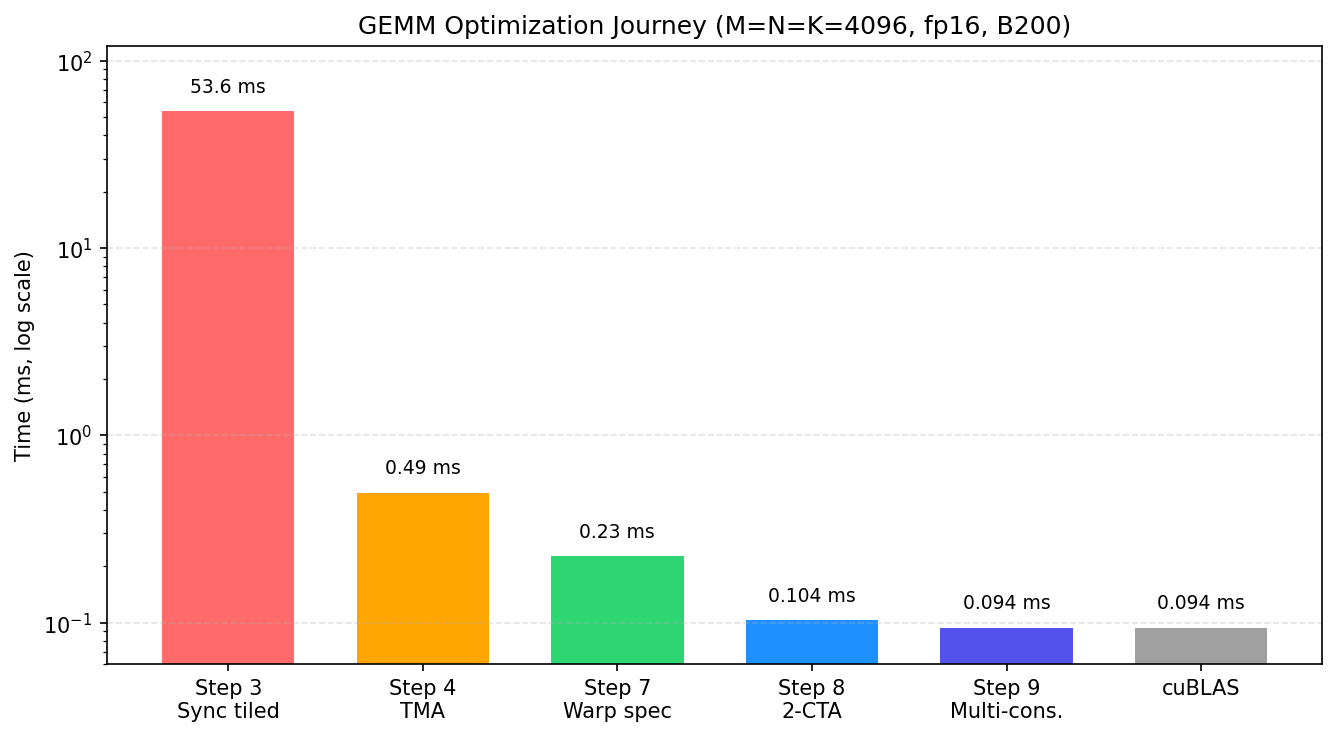
Across these nine versions, the optimization has two recurring goals: keep the Tensor Core from waiting for data, and perform more computation with each tile brought on chip.
Steps 1 through 3 begin with one \(128\times128\) output tile, add the K-loop, and tile the M and N dimensions to cover a full matrix. Steps 4 through 7 then improve the supply of data: TMA moves the tiles, double buffering prepares the next K tile, the persistent scheduler keeps CTAs working, and warp specialization allows load, MMA, and writeback to advance concurrently. By Step 7, the Tensor Core no longer has to wait for an entire load or writeback path to finish before computation can continue.
The final two steps improve reuse. The two-CTA cluster computes a larger output tile, allowing each A and B tile to participate in more multiply-adds. The second MMA consumer then lets two A blocks share the same B tile. Each transfer from GMEM consequently supports more on-chip computation.
In this B200 run, combining TMA, software pipelining, persistent scheduling, warp specialization, and cluster-level reuse reduces runtime from 70 ms to 0.094 ms, matching cuBLAS under the same test conditions. The result comes from coordinating several optimizations across data movement, execution overlap, and on-chip reuse rather than from any single mechanism.
Exercises#
What happens if you set the initial
phaseto0for both the TMA and MMAPipelineStatein Step 7? Draw the deadlock scenario.With
cta_group=2in Step 8, the TMA arrive byte count isCTA_GROUP * (BLK_M*BLK_K + BLK_N*BLK_K) * F16_SIZE. Why multiply byCTA_GROUPwhen each CTA loads its own data?In Step 9, the two consumers extend the output tile along M: they handle different M rows but cover the same N columns. Why can they reuse B in this mapping? If they instead extended along N, which operand could be reused?